|
|
Forecast Tools
|
Verification
|
Related Outlooks
|
About Us
|
Contact Us
|
As of the May 19th, 2017, release, Week 3-4 outlooks precipitation outlooks are experimental, whereas the temperature outlooks are operational. Both are issued Friday between 3pm & 4pm Eastern Time.
|
|
|
HOME>
Outlook Maps>
Week 3-4 Outlooks
|
|
|
Week 3-4 Outlooks
|
Valid: 17 Jan 2026 to 30 Jan 2026
Updated: 02 Jan 2026
|
|
Temperature Probability
|
Precipitation Probability
|
Week 3-4 500-hPa Height Outlook
|
|
Click HERE for info about how to read Week 3-4 outlook maps
|
|
|
Prognostic Discussion for Week 3-4 Temperature and Precipitation Outlooks
NWS Climate Prediction Center College Park MD
300PM EST Fri Jan 02 2026
Week 3-4 Forecast Discussion Valid Sat Jan 17 2026-Fri Jan 30 2026
The El Niño Southern Oscillation (ENSO) Alert System Status is set to La Niña advisory. Equatorial sea surface temperatures are below average across the central and east-central Pacific Ocean. Atmospheric anomalies over the tropical Pacific Ocean are consistent with La Niña. La Niña is favored to continue over the next month or two, with a transition to ENSO-neutral conditions forecast in January-March 2026 (68% chance). The current ocean heat content in the upper 300-meters is beginning to show an erosion of the cooler ocean temperatures in the eastern equatorial Pacific. Warm temperature anomalies now stretch eastward to 120W with positive anomalies deepening in the western equatorial Pacific over the past month. This may indicate the transition from La Niña conditions to more ENSO neutral conditions is occurring.
The Real-time Multivariate Madden-Julian Oscillation (RMM, MJO) signal over the past several weeks has been weak and disorganized, allowing other modes of variability to drive convection and circulation anomalies throughout the tropics. La Niña related ocean and atmosphere anomalies persist, but have become more confined across portions of the equatorial Pacific. Dynamical models consistently favor little to no reemergence of coherent subseasonal activity in the coming weeks, with large ensemble spread covering various phases in RMM space. If any renewed MJO activity were to occur later in January, the western Pacific appears most likely based on upper-lever velocity potential and lower level zonal wind anomaly forecasts.
Broad features of the 500-hPa height anomaly forecasts are fairly well aligned across the dynamical models for the outlook period. Each model forecasts an anomalous ridge over Alaska and the North Pacific Ocean, an anomalous trough over eastern Canada, and an anomalous ridge over the southern tier of CONUS. The models vary on the placement of the gradient between these anomalous pressure fields. The ECMWF model digs the trough the furthest south, reaching into the Ohio Valley. The JMA model also brings the trough into the Ohio Valley but expands the negative height anomalies the furthest westward to the Pacific Northwest. The CFS and GEFS solutions are more conservative with the southern reach of the trough and keep that boundary along the southern portion of the Great Lakes region and westward across the Northern Plains. Uncertainty in the position of these anomalous pressure gradients plays a role in the temperature and precipitation forecasts for this outlook.
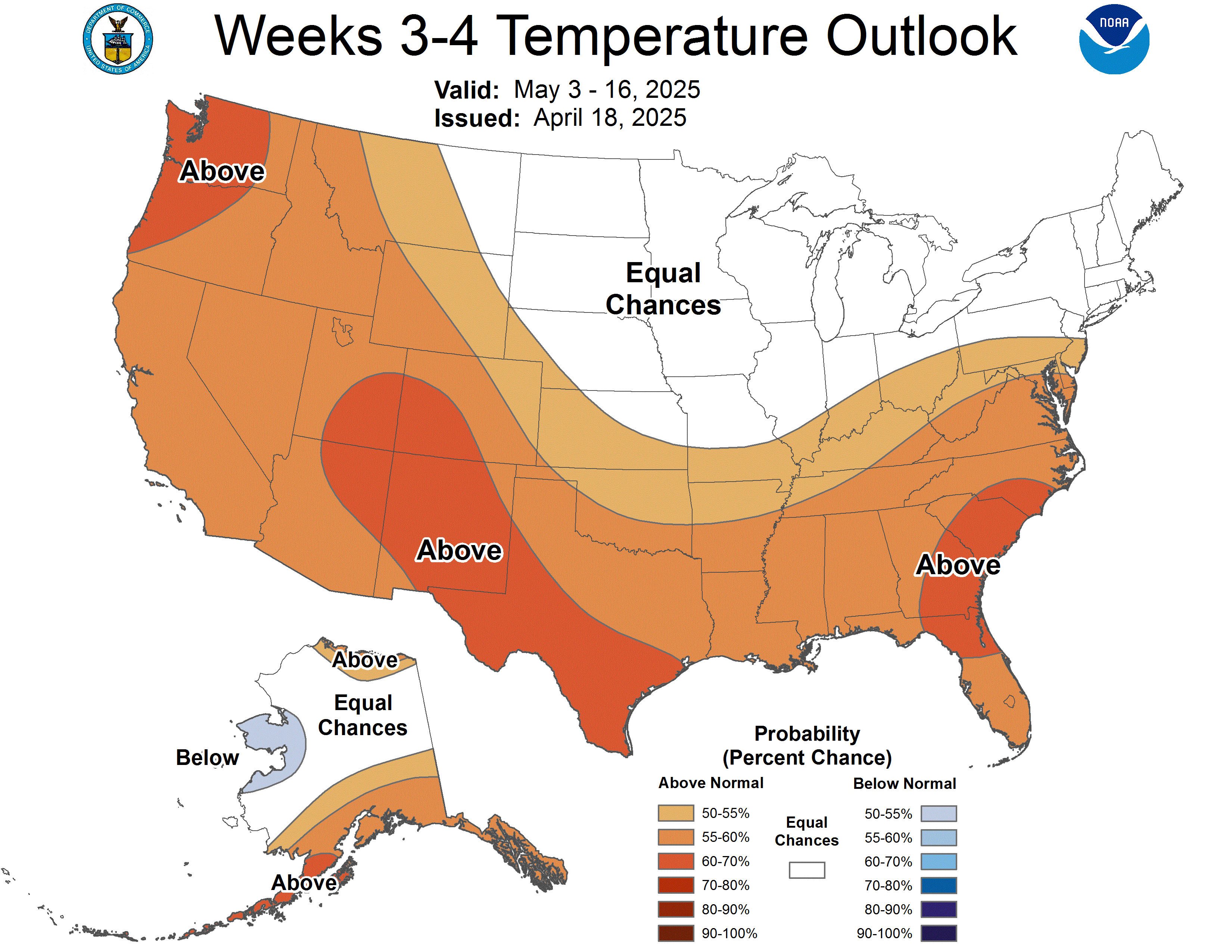
The temperature forecast across the model guidance was fairly well aligned with model agreement on favoring warmer than average conditions across most of Alaska and most of the western third of CONUS. Models also agree on increased chances for cooler than average conditions across the Upper Mississippi Valley, Great Lakes, Northeast, and Alaska Panhandle. Models disagree on conditions in Washington and on how far south cooler conditions may creep into the Central Plains and Southeast. The JMA is bullish with cooler conditions favored furthest south reaching the Central Gulf Coast and westward into the Southern Plains. The CFS is more conservative and restrains cooler than average conditions to the Great Lakes. The ECMWF and GEFS solutions are moderate with the extent of cooler than normal conditions and disagree specifically across the Central Plains. The ECMWF favors warmer than average conditions and the GEFS favors cooler than average conditions. These mixed signals from the model guidance plays a role in the location of Equal Chances across the temperature outlook. The highest probabilities for warmer than normal conditions are across the Great Basin, much of the West Coast, Southwest, Southern Plains, Gulf Coast, and North Slope of Alaska. The highest probabilities of cooler than average conditions are across the Northern Plains, Upper Mississippi Valley, Great Lakes, and Northeast.
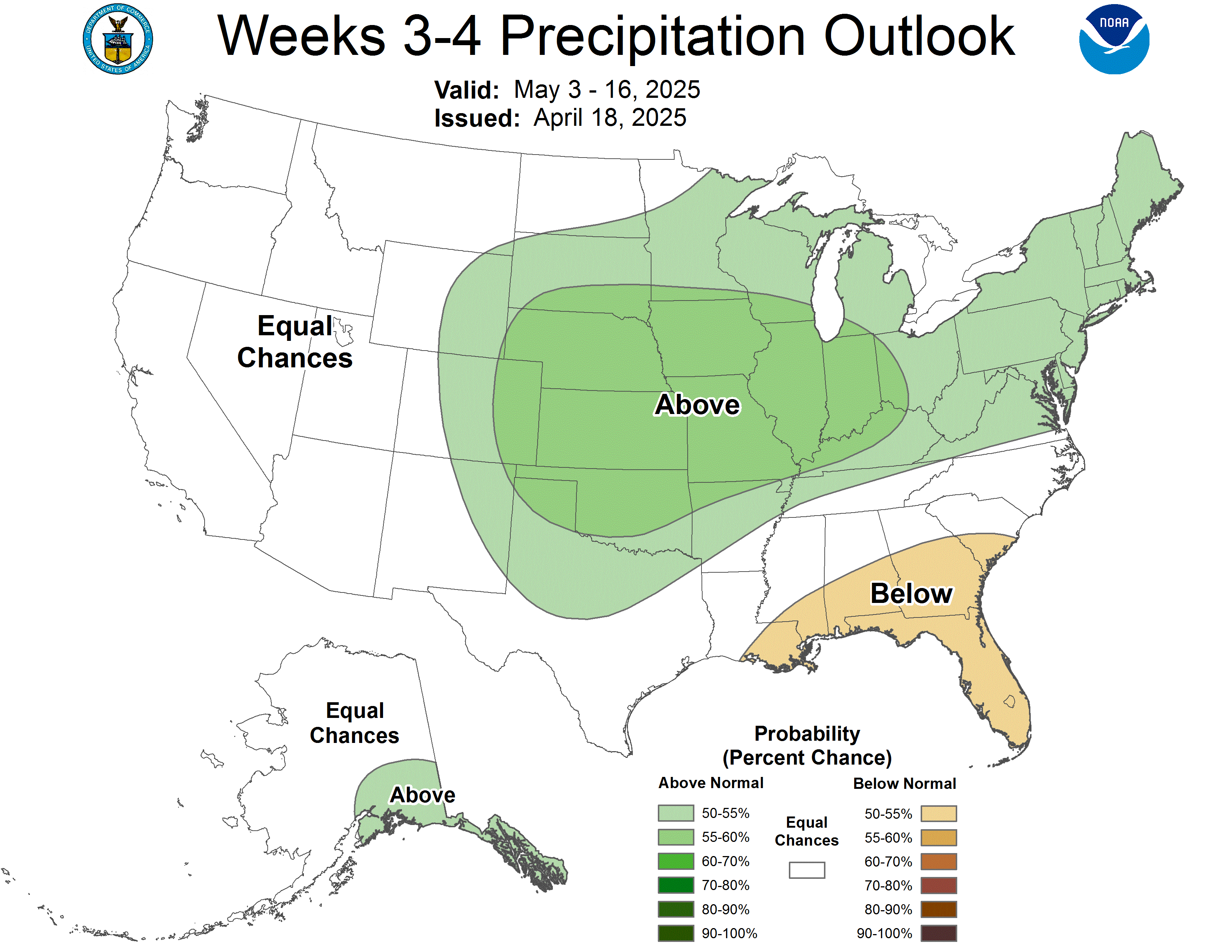
A blend of dynamical model guidance and statistical tools forecast the highest chances for above normal precipitation across the Northern Rockies, Northern Plains, and Central Rockies. Across the Upper Great Lakes and Ohio Valley, a slight tilt toward increased precipitation amounts is forecast by the blended guidance, however it is worth noting that individually the models differ on the location of the precipitation signal. The GEFS is the most bullish with above normal precipitation favored from the Great Lakes through the Midwest and south to the Tennessee Valley and Mid-Atlantic Seaboard. The ECMWF and JMA also favor above normal precipitation across the Tennessee Valley and central portions of the Mid-Atlantic Seaboard, but differ on the signal further north. The CFS keeps the elevated precipitation amounts restrained to the Ohio Valley. Given the model guidance in this region, the outlook indicates low probabilities of above average precipitation for the Ohio Valley and into the Great Lakes. Model guidance agrees fairly well on a forecast of near normal precipitation across the Central and Southern Plains. Moving westward, the model guidance becomes more mixed. The ECMWF and GEFS forecast near normal precipitation for California and elevated precipitation amounts for the Pacific Northwest. The CFS favors near normal precipitation for Southern California and drier than normal conditions for Northern California and the Pacific Northwest. The JMA favors drier than normal conditions for California and coastal Washington and Oregon, but then favors increased precipitation amounts for the Northern Great Basin. Given the mixed model guidance, Equal Chances is forecast along the West Coast and most of California. For Alaska, Equal Chances is forecast for most of the state due to a mix of model signals. The ECMWF favors near normal conditions, the GEFS favors above normal precipitation, the JMA favors drier than normal conditions, and CFS is a mix of all three. In deference to the majority of guidance for Alaska, enhanced probabilities of drier than average conditions are favored for parts of the Southern Interior, much of the South Coast, and the Aleutian Islands. Equal chances is forecast elsewhere across Alaska due to mixed model guidance.
For Hawaii, surrounding SST anomalies continue to be above normal. The outlook favors above normal temperatures and above normal precipitation for all the islands.
Forecaster: Emerson LaJoie
The next week 3-4 outlook will be issued on Friday, Jan 09, 2026
These outlooks are based on departures from the 1991-2020 base period
These are three category outlooks consistent with what is currently used for the monthly and seasonal forecasts.
The shading on the temperature map depicts the most favored category, either above-normal (A), below-normal (B), or near-normal (N) with the solid lines giving the probability ( >33%) of this more likely category (above, below, or near).
The shading on the precipitation map depicts the most favored category, either above-normal (A), below-normal (B), or near-normal with the solid lines giving the probability ( >33%) of this more likely category (above, below, or near).
In areas where the likelihoods of 2-week mean temperatures and accumulated precipitation amounts are similar to climatological probabilities, equal chances (EC) is indicated.
|
|
|
|
An ASCII (w/ HTML markup tags) text version of the written forecast is available.
|
|
|
 www.nws.noaa.gov